UPI Laboratories Europe BV is specialist in the calibration and supply of hardness testing indenters and equipment, including advanced tools for Knoop hardness testing. Thanks to our high-quality Knoop indenters and reliable test equipment, you can be sure of consistent results. Our team ensures every product is calibrated to both ISO and ASTM standards. With ISO/IEC 17025 accreditation by the Dutch Accreditation Council (RvA), UPI guarantees accurate and reliable testing tools that meet the international standards.
The Knoop hardness test is a microhardness testing method designed for thin materials or small parts. Unlike the Vickers test, which uses a symmetrical diamond pyramid, the Knoop method uses an elongated diamond-shaped indenter. This creates a narrow, shallow indentation with a long diagonal.
This unique shape makes the Knoop test ideal for measuring surface hardness with minimal penetration, which is particularly useful for fragile or coated samples. The test is performed by applying a precise force, usually between 10 gf and 1,000 gf, for a specific amount of time (dwell time). The size of the indentation, especially the long diagonal, is then measured under a microscope.
Because the indentation is not symmetrical, measurements are sensitive to specimen preparation and surface condition. For forces below 200 gf, slight irregularities can influence the result. That’s why proper polishing and surface preparation are crucial for repeatable and accurate outcomes. The result of the test is given in Knoop hardness number (HK), calculated from the test force and the measured indentation.
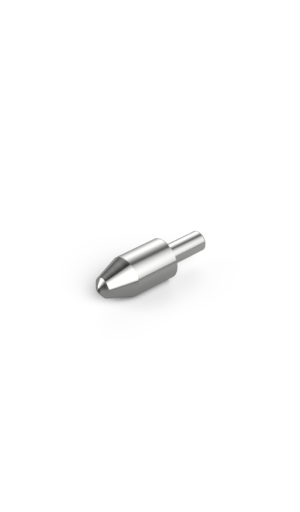
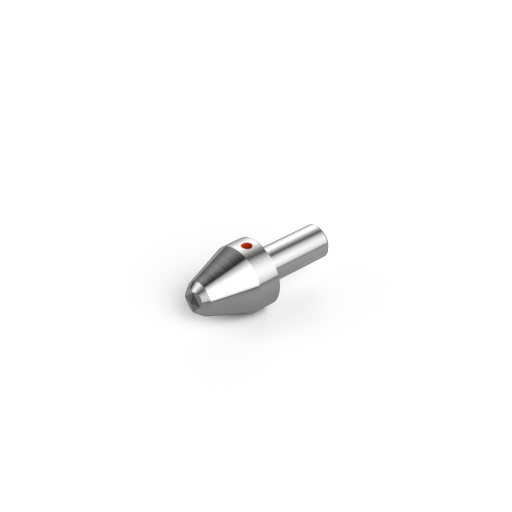
The Knoop indenter is a diamond with an elongated shape, optimized for small-area testing. At UPI Laboratories Europe BV, we supply only dual calibrated indenters that comply with ISO and ASTM standards. Every diamond is mounted with precision to align with its grain structure, ensuring durability and consistency. Knoop indenters are especially suitable for:
Because the indentations are small and shallow, they don’t damage the sample and allow you to analyze multiple areas. However, due to the asymmetrical shape, proper calibration and calibrated equipment are essential to avoid measurement errors.
We evaluate every indenter with laser scanning microscopes, verifying dimensions and quality before delivery. Our lab operates under ISO/IEC 17025 accreditation, ensuring full traceability and compliance with international standards.