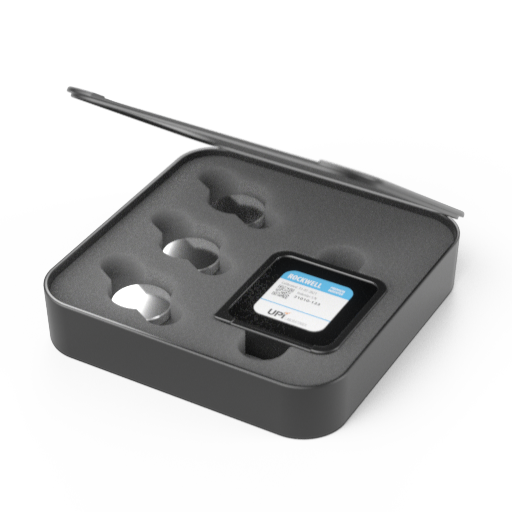
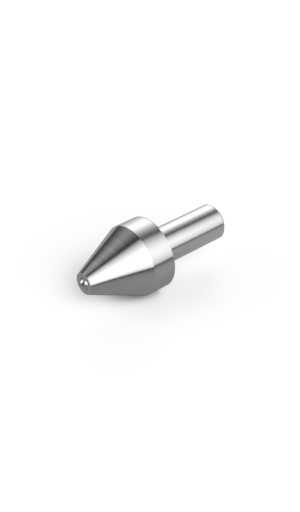
Diamond hardness in Rockwell testing refers to the use of a diamond cone indenter to measure the hardness of materials with a high resistance to permanent deformation. This testing approach is essential for accurately evaluating hardened metals and alloys where softer indenters would deform, wear, or produce unreliable results. At UPI Laboratories Europe BV, Rockwell diamond hardness testing is supported through calibrated diamond indenters, reference test blocks, and accredited calibration services performed under ISO/IEC 17025 RvA accreditation.
In Rockwell hardness testing, a diamond indenter is used in the form of a cone-shaped penetrator, commonly referred to as a brale. During the test, the diamond indenter is pressed into the material surface following a defined sequence of loads. The hardness value is determined by measuring the permanent depth of penetration after unloading.
The diamond indenter features a standardized geometry, including a 120-degree cone angle and a specified spherical tip radius. These parameters are strictly defined to ensure consistent contact with the test surface and reliable depth measurement. Because the Rockwell method is depth-based rather than optical, even minor deviations in indenter geometry can directly affect hardness readings.
Diamond indenters are therefore essential for Rockwell scales designed for harder materials, where ball indenters may produce excessive deformation or unstable measurements.
Diamond indenters are suitable for Rockwell hardness ranges that involve high material resistance to indentation. They are commonly used for testing hardened steels, tool steels, bearing steels, and other high-strength alloys.
In these hardness ranges, diamond provides the durability required to maintain indenter geometry under repeated testing cycles. Softer indenters, such as carbide balls, may flatten or wear when applied to hard materials, leading to incorrect results and reduced repeatability.
By using a diamond indenter, hardness values remain consistent across repeated tests and between different machines, provided that proper calibration and verification procedures are followed.
Metals with high resistance to plastic deformation require stable and precisely controlled testing conditions. Diamond hardness Rockwell testing is well suited for materials such as quenched and tempered steels, surface-hardened components, and heat-treated alloys used in demanding mechanical applications.
In production environments, Rockwell diamond testing is often used to verify heat treatment processes and confirm that components meet specified hardness limits before assembly or shipment. In research and development, it supports comparison of alloy compositions, surface treatments, and process parameters.
Because these materials are frequently used in safety-critical applications, reliable hardness data is essential. Calibrated diamond indenters and hardness test blocks help ensure that measured hardness values accurately reflect material properties.
The Rockwell C scale is one of the most commonly used hardness scales for testing hard metallic materials with a diamond indenter. Compliance with Rockwell C scale standards requires strict adherence to defined test parameters, including applied loads, dwell times, indenter geometry, and overall machine performance.
Standards such as ISO 6508 and ASTM E18 specify the requirements for Rockwell hardness testing and mandate the use of properly manufactured and calibrated diamond indenters. Regular verification using calibrated reference test blocks is required to confirm system accuracy.
UPI Laboratories Europe BV supplies high-quality diamond cone indenters, calibrated reference test blocks, and accredited calibration services to support reliable and compliant testing.
All diamond indenters supplied by UPI Laboratories are precision manufactured, carefully calibrated, and delivered with calibration confirming compliance with relevant ISO and ASTM standards. Calibration services are performed under ISO/IEC 17025 RvA accreditation, ensuring technical competence and international recognition of results.
For technical specifications, calibration services, or ordering information, contact UPI Laboratories Europe BV via the online form or download our catalogue.