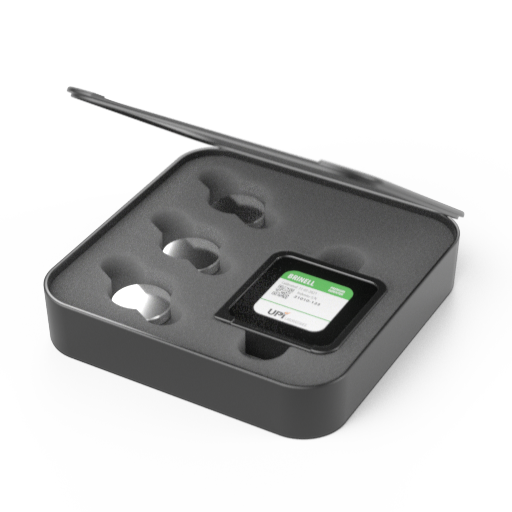
Brinell hardness is a well-established method for evaluating the strength and durability of materials. It measures resistance to indentation under a defined load and is especially suitable for large or coarse-grained metals such as steel, cast iron, and aluminum. At UPI Laboratories, we supply calibrated Brinell test blocks, precision balls, and complete sets, that ensure your testing is accurate, traceable, and compliant with international standards.
The Brinell hardness test works by pressing a tungsten carbide ball into the surface of a material under a heavy load, typically ranging from 500 to 3000 kgf. After the load is removed, the diameter of the indentation is measured using a microscope or optical device. The Brinell hardness number (HBW) is then calculated by dividing the applied load by the surface area of the indentation.
Because the Brinell indenter creates a relatively large impression, the test averages out hardness over a broader area. This makes it especially suitable for materials with coarse or heterogeneous structures, such as castings or forgings, where smaller-scale methods like Vickers may produce misleading results.
Brinell hardness testing is widely used in heavy industries that require dependable data on bulk material properties. In the steel industry, it is applied to structural steels and welds, while the automotive sector uses it for engine parts, gears, and frames that face high stress. The aerospace industry relies on Brinell values for alloys in landing gear and structural components, and foundries test large castings and forgings to verify quality.
Because Brinell testing is standardized and globally recognized, it provides a common basis for specifications across supply chains. Reliable results depend on calibrated reference blocks and precision balls to ensure reproducibility.
The choice of ball diameter and applied load is central to achieving valid Brinell test results. Common ball sizes range from 1 mm to 10 mm, with the load adjusted in proportion to the ball diameter and material being tested. For example, softer materials such as aluminum require a smaller load with a larger ball to avoid excessive penetration, while harder materials like steel demand higher loads for accurate measurement.
Modern Brinell testing standards, such as ISO 6506 and ASTM E10, specify the correct ball and load combinations for different materials. They also recommend the use of tungsten carbide balls instead of steel in most applications, since carbide is harder and more resistant to wear. By following these standards and using precision-made balls, laboratories can ensure that their Brinell hardness values are both accurate and comparable across facilities.
Just like with other hardness testing methods, calibration is essential in Brinell testing. Brinell reference blocks provide the benchmark for verifying that testing machines are applying the correct load and measuring indentations consistently. Without regular calibration, even high-quality equipment may drift over time, leading to unreliable results.
UPI Laboratories supplies calibrated Brinell hardness test blocks that comply with ISO and ASTM standards, ensuring that every test remains accurate and traceable. These blocks are an indispensable tool for laboratories that require dependable Brinell results for quality control, certification, and research.
UPI Laboratories supports your Brinell hardness testing with a complete range of reference tools. Our calibrated Brinell test blocks provide the benchmark, while our precision tungsten carbide balls ensure repeatable indentation performance. For laboratories and production environments that need a full solution, we also offer complete Brinell sets combining blocks and indenters in one package.
By choosing UPI Laboratories, you gain access to reference tools that meet the strictest international standards, reduce measurement uncertainty, and give you confidence in your hardness results. Whether you are working in heavy industry, research, or quality assurance, our products provide the foundation for reliable Brinell hardness testing.
Contact our team today to learn more about our Brinell reference tools and discover how UPI Laboratories can help you achieve consistent, traceable hardness results.