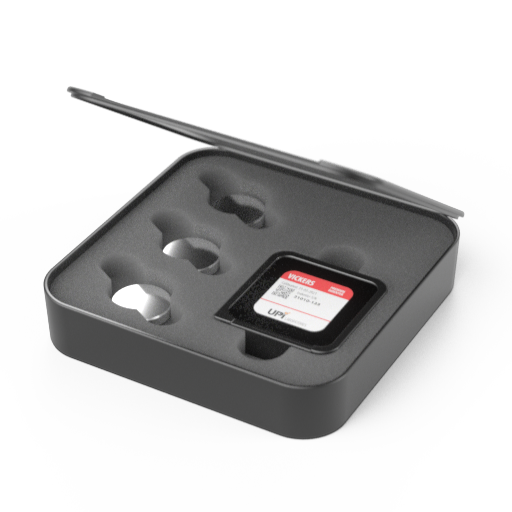
A Vickers hardness tester is a key instrument used for measuring the hardness of materials through highly precise and versatile testing. It’s ideal for evaluating thin materials, coatings, and microstructures across various industries. UPI Laboratories Europe BV supplies certified Vickers indenters and reference blocks calibrated under ISO/IEC 17025 RvA accreditation, supporting consistent and accurate testing.
The Vickers test method uses a diamond-shaped indenter in the form of a square-based pyramid. This indenter is pressed into the surface of the material under a specific load, typically ranging from a few grams to several kilograms. After the load is removed, the diagonals of the resulting indentation are measured to calculate the Vickers Hardness Number (VHN or HV).
One of the biggest advantages of the Vickers test is that it uses a single indenter for all materials and test loads. This allows for testing across a wide range of applications—from soft metals to hardened alloys—without the need for multiple indenters.
The Vickers method is especially useful for testing small parts, coatings, or material samples where traditional macro hardness tests would be unsuitable. It’s widely used in research, quality control, and industries such as electronics and aerospace.
The result of a Vickers test is presented in HV (e.g., 420 HV30), where the number represents the hardness, and the load used (in kilograms-force) follows. If the dwell time deviates from the standard (10–15 seconds), the time is also indicated (e.g., 420 HV30/20).
Vickers hardness units are particularly useful because they can be applied across the entire hardness range with high accuracy. Unlike other methods, Vickers offers geometrically similar impressions at any load, which ensures consistency in results. This makes the method highly suitable for cross-material comparisons.
Common applications include:
Thanks to its fine resolution, the Vickers method is also essential in microhardness testing, where very light loads are used to evaluate localized hardness variations.
In materials development, researchers use Vickers data to analyze the mechanical behavior of new alloys, composites, and advanced ceramics. The method supports both comparative testing and long-term studies.
The Vickers method is ideal for practical situations where detailed, localized hardness measurements are needed. It can detect changes in hardness across a weld, assess surface treatments, or evaluate electronics components.
Because it uses light loads and leaves minimal indentations, it’s useful when testing delicate samples or finished parts. This makes it a non-destructive yet informative testing technique.
Modern Vickers testers often include image recognition software to speed up analysis and reduce user bias.
When selecting a tester, consider the application. For microhardness testing, choose a model with low-load capability and high precision. For macrohardness testing, use testers with higher load capacity and stable stage movement. This ensures accurate and repeatable results.
Certified accessories are essential for consistent results. UPI Laboratories supplies precision-mounted Vickers indenters and dual-certified reference blocks. All items are calibrated under ISO/IEC 17025 RvA accreditation.
Regular calibration and proper machine setup help maintain accuracy. UPI Laboratories also offers documentation and support to help teams meet standards and maintain best practices.
Reliable hardness testing equipment is essential for accurate results. UPI Laboratories Europe BV supports your testing operations with certified Vickers indenters, reference blocks, and calibration services.
Download our brochure or contact us to find the right tools for your application.