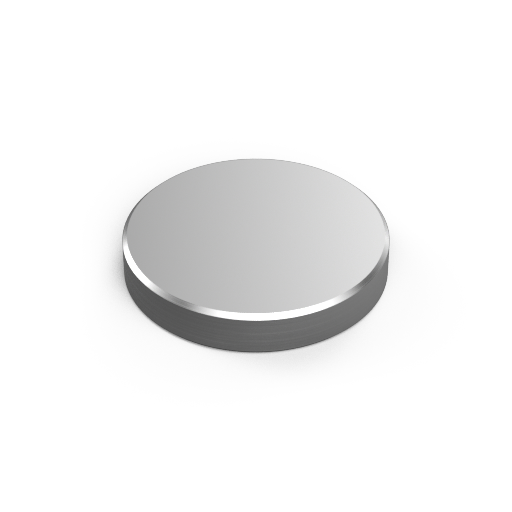
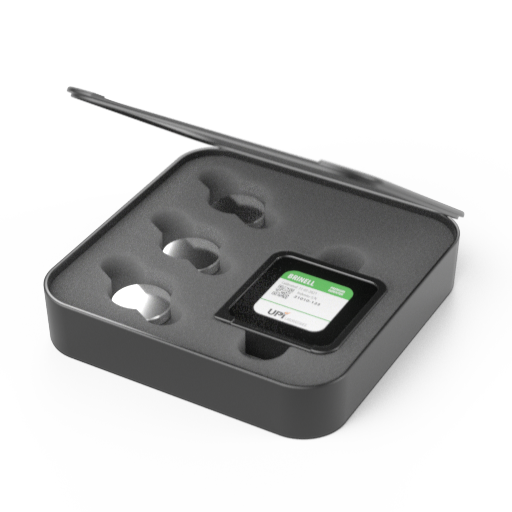
When comparing hardness testing methods, Vickers and Knoop are two of the most widely used microhardness tests. Both methods use a diamond indenter and are designed to measure the hardness of materials with high precision. However, there are key differences in the way each test is performed and in the type of applications they are best suited for. UPI Laboratories Europe BV is accredited under ISO/IEC 17025 and provides calibration and supply of high-quality Vickers and Knoop hardness testing indenters.
The Vickers and Knoop tests are both based on the principle of pressing a diamond indenter into the surface of a material under a specific load and measuring the size of the resulting impression. The Vickers test uses a square-based pyramid-shaped diamond, while the Knoop test uses an elongated diamond with a rhombic shape.
Because of their geometry, the impressions left by each test differ in shape and measurement approach. The Vickers indenter produces a symmetrical, square-shaped impression, whereas the Knoop indenter leaves an elongated mark with one long and one short diagonal. This difference allows each test to be used in distinct applications: Vickers for general and versatile hardness testing, and Knoop for thin layers, coatings, or very small specimens.
Both Vickers and Knoop tests are part of UPI Laboratories’ calibration scope under ISO/IEC 17025 accreditation. Our laboratory provides diamond indenters precisely calibrated to meet both ISO and ASTM requirements, ensuring accuracy, consistency, and traceability.
Vickers hardness testing is one of the most versatile methods available. It can be applied to almost all metals and offers a wide testing range. The method is highly accurate because the hardness value (HV) does not depend on the size of the indenter or test load.
A Vickers test is particularly useful for general material evaluation, quality control, and research and development. It provides consistent results across different test loads, typically between 500 gf and 50 kgf. The results are expressed as HV (Hardness Vickers) values.
Vickers hardness testers are widely used in the automotive and aerospace industries, in laboratories, and in material research settings.
The Knoop test is derived from the Vickers method but uses a differently shaped indenter. The diamond indenter has a long and short diagonal, making it ideal for testing thin coatings, surface layers, or small, delicate components.
Knoop testing is often used when very small areas need to be measured, such as near edges, corners, or microstructures. It is especially suitable for evaluating surface hardness and gradient variations in hardness across thin materials.
Because the indentation is shallow, the Knoop test is sensitive to specimen preparation and surface quality. It is typically performed with lower test forces, often below 1 kgf, to avoid damaging the material.
The choice between Vickers and Knoop hardness testing depends on your application, sample type, and surface conditions.
For both methods, reliable calibration and traceability are essential to guarantee valid results. UPI Laboratories Europe BV ensures this by operating under ISO/IEC 17025 accreditation with RvA recognition, meaning all results are internationally accepted through ILAC signatory agreements.
UPI Laboratories Europe BV can guide you in, calibrating, and accrediting your hardness testing indenters. We supply dual calibrated diamond indenters that meet both ISO and ASTM standards, ensuring accuracy and reliability for your test setup.
Contact our team for expert advice or to request our catalogue.
Get in touch via our contact form or email us to learn more about our calibration services and high-precision hardness test blocks.